Accountability: What Could Go Wrong?
 Susan Mogensen
  June 18, 2019
Susan Mogensen June 18, 2019 Susan Mogensen June 18, 2019 Susan Mogensen June 7, 2019 Susan Mogensen October 1, 2018
When organizations have a board member serving as Treasurer, significant dysfunction can emerge in the relationship between the board and the CEO. On one hand, the board has delegated the accomplishment of results within certain boundaries to the CEO, and on the other hand, the Treasurer is expected to oversee, manage, and/or question any/all operational decisions made regarding financial matters.
 In other words, both the CEO and the Treasurer are each given the illusion that they are accountable for sound financial management, with the board as a whole often acting like an arbiter between the two.
Policy Governance principles clarify governance and management roles with respect to all decisions, including financial ones. In short, the board sets out the criteria for prudent and ethical financial planning, activities, asset protection, board expenses, the overall worth of the results achieved, and possibly more. The CEO follows these criteria, and regularly provides the board with evidence of compliance with a reasonable interpretation of these criteria.
For answers to common questions about this topic, download and share this Financial Management FAQ with your board and staff members, or take our Board EXCELerator online course to learn how to make Policy Governance principles clarify roles and benefit your organization.

See also: Board Policy Example – Treasurer’s Role
Susan Mogensen May 24, 2018About two years ago, a very insightful client of ours suggested we make the ‘flipped classroom’ concept available for Policy Governance orientation.
According to Wikipedia, “a flipped classroom is an instructional strategy and type of blended learning that reverses the traditional learning environment by delivering instructional content, often online, outside of the classroom. It moves activities … into the classroom.”1
 When so many boards are pressed for time and resources for high quality training, we took this suggestion to heart. Brown Dog Consulting is now happy to offer clients an innovative new online learning program that orients board and staff members in the theory and practice of Policy Governance.
Govern With Confidence: 10 Key Principles for Effective Board Leadership (short title – Board EXCELerator) delivers all of the core content necessary to understand what Policy Governance is, and how to benefit from applying its 10 principles. Participants are guided through all 10 principles via eight course modules featuring audio clips, short videos, illustrated slides, and quick quizzes to confirm that key points are understood every step of the way.
The course also includes discussion guides that boards can use to stimulate group conversation during board meetings, plus practical application tips and one-on-one coaching for each course participant.
Boards can use this course to orient new board or staff members, to refresh memories of Policy Governance training or books read in the past, to get all board members on the same page with respect to the application of Policy Governance principles, and to prepare board members before hosting a facilitated board retreat. When all board and staff members understand Policy Governance principles before attending a face-to-face workshop, participants can delve more deeply into important issues and perform at a much more advanced level.
For more information about this innovative new way to save board meeting time and resources, and to accelerate your board’s performance, please connect with us and we’ll get the ball rolling!
Susan Mogensen May 19, 2018If your board or organization is asked about why it uses Policy Governance, here are five main benefits to share.
Results: Policy Governance focuses boards on ensuring that the organization achieves relevant results. Applying Policy Governance principles lets boards connect all the dots from owner input to board policy to policy interpretation to evidence of accomplishment.
 Accountability: Boards can govern confidently because they know how to be accountable to whom for what, and have a system in place for ‘making it so.’
Flexibility: Boards using Policy Governance principles have tremendous flexibility and room for creativity. Arguably, people serving on and for boards using Policy Governance have much more flexibility to achieve results than those using a ‘traditional’ model. That’s because when core principles and expectations are clear, common misunderstandings and frustrations are minimized. Further, the principles facilitate an innovative, agile approach for CEOs and staff, and boards can create as many or as few policies, processes and practices that they need.
Clarity: Better communication between boards and CEOs is enabled because roles, responsibilities, and policies are clarified. Common misunderstandings, frustrations and duplication of effort are minimized because board members, the CEO, and staff are clear on all performance criteria and how evaluation will occur.
 A Practical Approach: Policy Governance principles focus boards on what’s important, and enable policy development that is both comprehensive and concise. Boards save time spent in board meetings, and CEOs and staff can achieve results more efficiently.
If your board is not yet fully benefiting from applying Policy Governance principles, contact us about coaching, workshops, and our online learning course.

Learn Policy Governance online.
Susan Mogensen May 4, 2018Anytime a board member has a concern with operational situations or processes, they can take the following steps:
 1. Check to make sure the underlying concern is covered (put off limits) by one or more Executive Limitations policies. Check for both broadly stated policies (e.g., the CEO shall not allow anything “unethical or imprudent”) as well as more specific provisions, and everything in between.
1. a) If there doesn’t seem to be a relevant or specific enough policy relating to the concern, a board member can propose a policy amendment to the board.
2. Check to see how the policies relating to the concern were interpreted. When was compliance with the policy last monitored? What did the board decide when last reviewing the reasonableness of these interpretations? Has the board’s opinion changed? (If no monitoring report has been received, when is one expected? Does the board need to request an urgent/special submission of a monitoring report?)
 3. If the interpretations were deemed reasonable, check the evidence of compliance with the policy interpretations. What has the board said or agreed when checking the evidence for compliance with the interpretations? Has new information emerged? Has the board’s opinion changed?
3. a) For added certainty, if the board would like to see evidence from a different source, the board can change the monitoring methods used per the monitoring schedule, i.e., occasionally use the External and/or Direct Inspection methods to obtain the evidence aligning with the CEO’s interpretation in an Internal report.
4. If there are any issues with the reasonableness of the policy interpretations or the evidence, the board can choose from multiple options along a continuum of severity/urgency, depending on the risk and the situation. These options range from allowing the non-compliance issue to stand temporarily, to requesting a revised monitoring report bringing the matter into compliance, and continue all the way to CEO dismissal. Alternatively, the board could choose to change the policy.
5. Would the board as a whole like to see certain information from the CEO regardless of, or in addition to, what is provided via the monitoring process? If so, it should describe that information in its Executive Limitation policy, ‘Communication and Support to the Board,” (if it has one).
6. Would the board as a whole like to learn more about certain operational processes? If so, it can add the topic to the Board’s Education Plan and arrange or request a presentation on the topic at a future board meeting.
A note for CEOs: Understand that as board composition changes, policy interpretations that were previously deemed reasonable by a majority of the board might no longer meet that test. It is common for CEOs to fine-tune and strengthen policy interpretations where possible. This process is not easy, but the time/energy spent developing and reviewing interpretations and evidence should diminish over time.
 A note for Board Members: Governing requires boards to direct (via policy), and then see to it that the direction has been fulfilled (via monitoring). Policy-making and monitoring are powerful mechanisms available to the board, alleviating any perceived need to ‘micromanage’ or to do the work of the CEO.
See also: The Ultimate Troubleshooting Guide for All Boards of Directors
and Understanding the ‘One Voice’ Principle
Susan Mogensen April 2, 2018Whenever a person or group of people delegate a task or objective to another person or group of people, this is what we expect will happen.
 Someone in a position of authority (e.g., citizens, members, shareholders, a board of directors, a boss) communicates clear objectives to a delegatee, who, by virtue of the role they accepted, is empowered to achieve those objectives. Once an objective has been achieved, the authority sees and acknowledges the results.

If the results don’t match the objective, the objective might be clarified, or some corrective measure(s) might be taken.
A major source of frustration occurs when a spurious influence disrupts this flow of objectives/expectations transforming into results/compliance.

This influence could be fairly benign, such as a distraction or a suggestion that replaces the original objective, or corrupt, such as a bribe or a threat from an outside party. In the more serious cases, this ethical breach means that the original authority does not get the expected result, or at the very least not in a timely manner, and is often left not knowing why.

To guard against spurious influences, organizations and democracies must always work to strengthen the structural integrity of their systems. This is no small task, but it is aided by (1) societal norms around truth-telling and integrity, (2) group decision-making methods that encourage information sharing (facts) and that develop mutual understanding, and (3) widespread use of good governance principles.
See also: Quick, What is Policy Governance Again?
and “Personnel is Policy”? Let’s Try: Policy is Policy
and Policy Governance is Much More Than Just Having Policies
 Susan Mogensen March 17, 2018
Many boards and organizations go to great lengths to develop statements or lists of values by which they intend to abide. But coming up with a list of values is of no use unless those values translate into actual behaviours. Does this situation look familiar?


As John Carver says, “I frequently encounter boards that have laboriously produced statements of mission, vision, values, and philosophy. Unfortunately, these statements … can remain just words on a page and never get reflected in any meaningful way in the organization.”1
Boards using Policy Governance principles translate their values into policies, and then check to see that behaviours match the criteria set out in those policies. The board’s words matter.
1Carver, John. “What to Do with Your Board’s Philosophy, Values, and Beliefs,” John Carver On Board Leadership. (San Francisco: Jossey-Bass, 2002), 191.

See also: What’s the Difference Between Vision, Mission, and Ends?
and Strategic Planning, Policy Governance-style
and Policy Governance is Much More Than Just Having Policies
Susan Mogensen March 17, 2018
Ends in Policy Governance is a three-fold concept. Ends policies must answer these three questions at least at the broadest level of policy: what benefit? For whom? At what worth?
Sometimes the “at what worth” concept is misunderstood or neglected but it’s a very important component of Ends and demands serious consideration by the board.
In for profit corporations, we expect some kind of Return on Investment or ROI. The “at what worth” part of Ends is a similar idea, and nonprofit and public boards might wish to research the “Social Return on Investment” or SROI concept.
Boards need to think through this question: are the results we’re producing for the recipients *worth* the investment? and that’s including financial and human resources and the opportunity cost.
Or think of the value equation. Does the worth of the results produced for recipients, subtract the investment to create those results, generate a positive net value?
WORTH – INVESTMENT = NET VALUE
Or put another way, does the WORTH / Investment yield a net value or return greater than 1?
Is WORTH / INVESTMENT > 1
Boards should consider whether or not the investment is worth the results. Could any or all of the results be produced as well or better for less by another organization? Could better results be produced if the cash equivalent of the investment were handed out? What value would be lost if the organization ceased to exist?
The “At what worth” policy component goes hand-in-hand with the iterative, dynamic nature of Ends and the systematic feature of Policy Governance. Boards might start with a general “at worth statement,” that is then interpreted by the CEO, which later prompts the board to fine-tune the Ends, perhaps giving priorities to some parts of Ends over others. The first steps are to understand the concept and gather relevant information, and then to have the conversation.
Board must also consider owner input, and know that the reasonableness of the CEO’s interpretation of Ends is going to factor heavily into this process.
See also: What’s the Difference Between Vision, Mission, and Ends?

Susan Mogensen October 27, 2017Policy Governance is a board governance model that clarifies the distinction between governance and management. In strategic planning, Policy Governance principles focus the board on outcomes, accountability, and organizational direction rather than operational decisions.
I often get asked, “How do boards using Policy Governance do strategic planning?”
Policy Governance principles provide clarity around who is accountable for which of the many elements traditionally contained within a strategic plan. In a nutshell, the board initiates the process at the broadest, most strategic level, delegates the accomplishment of its direction, and then checks for evidence of accomplishment of a reasonable interpretation of its direction. Here are 10 distinct steps in this process, along with the accountability for each.
Step 1: The board must first know to whom it is ultimately accountable, otherwise known as the “moral/legal ownership.” The owners might be defined as members, citizens, a regional community, people sharing a passion, or, in the case of for-profit corporations, shareholders. Take no further steps until the board is clear on the legal/moral ownership definition. Accountability: Board
 Step 2: The board obtains owner-level input from its owners by asking questions about the overall purpose of the organization and the difference in the world it should make. An owner-level question might be, for example, “If our organization is being successful, who in the world is benefitting in what way?” Accountability: Board
Step 3: The board also seeks, reviews, and analyses information from other sources, e.g., demographic information, industry research, and environmental scanning data. Accountability: Board
Step 4: The board considers the owner-level input, other good information, adds its own wisdom, and then creates or revises its Ends policies accordingly. (Seven examples of Ends policies are available here.) All other policies (Executive Limitations, Board-Management Delegation, and Governance Process) should exist as well. Accountability: Board
Step 5: The CEO (or whoever fills the lead operational role) then interprets the Ends, justifying the reasonableness of each interpretation and showing how achievement of each policy will be measurable or observable in some way. Accountability: CEO
Step 6: Plans, budgets, strategies, tactics (the “means”) are devised in order to achieve the Ends interpretations. Accountability: CEO
Step 7: The CEO and staff then carry out the plans and activities needed to achieve the outcomes outlined in the Ends interpretations. All operational activities must take place within the boundaries set by the Executive Limitations. Accountability: CEO
Step 8: Evidence of the outcomes of these activities are then aligned and reported together with the interpretations, and submitted in a monitoring report to the board of directors according to the monitoring schedule or on request by the boards as a whole. Accountability: CEO

Step 9: The board then assesses the monitoring report to ascertain if (1) the interpretations are reasonable, and (2) if the evidence supports compliance with or achievement of the interpretations. Accountability: Board
Step 10: Ends monitoring information is shared with the ownership and the process repeats. Accountability: Board
Note: The board, CEO, and staff can participate together in a group strategic planning session delving into steps 3 – 6, as long as everyone knows and acknowledges who is ultimately accountable for fulfillment of each step. A facilitated workshop could, for example, include board members who provide ideas or advice as “volunteer staff” (rather than as a board authority) for steps 5 and 6. Likewise, the CEO might offer the board advice and/or logistical support with steps 2 – 4. We recommend working with an experienced governance coach to ensure that collaboration does not result in confusion.
Boards might also choose to check the reasonableness of Ends interpretations before steps 6 and 7 take place, in which case they would request an interim or special Ends monitoring report showing the interpretation section only. Once the board deems the interpretations reasonable, the rest of the cycle can continue.
Need more info about this process? Check out our online board education program and access our Quick Guide in the Ten Steps in Strategic Planning, Policy Governance-style.
See also:
Susan Mogensen March 14, 2017The One Voice Principle in Policy Governance® means that the board governs as a single body rather than through individual board members acting independently. Authority rests with the board as a whole, not with individual directors, officers, or committees unless formally delegated by the board.
One frequently misunderstood Policy Governance® (Carver model) principle is the Board Holism (a.k.a. “One Voice”) principle, which states:
“3. Board Holism: The authority of the board is held and used as a body. The board speaks with one voice in that instructions are expressed by the board as a whole. Individual board members have no authority to instruct staff.”1
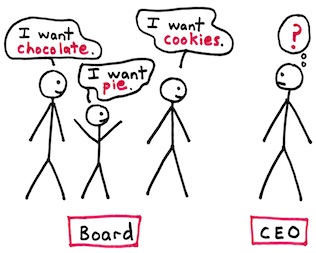
In other words, when the board provides instruction to the CEO, to a board committee or other delegatee, it expresses a singular direction reflecting the will of the board as a whole, and does not give multiple or conflicting directions.

The One Voice Principle in Action
If a board were to not use this principle, it would risk confusing the CEO (or delegatee) about what result or activity would demonstrate compliance with the board’s expectations, which in turn would diminish the board’s and CEO’s ability to be accountable.
The One Voice Principle NOT in Action
Boards usually understand this principle at some level, but then often confuse matters when a board committee or officer changes or replaces the expectation originally set by the board as whole.
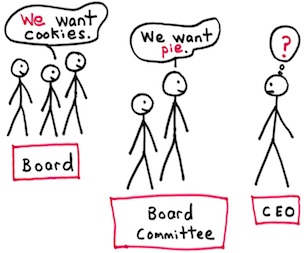
The One Voice Principle NOT in Action Again
The key is that this principle relates to delegation and not to the board’s outward facing communications strategy. Any board using Policy Governance is free to choose to communicate to the public with one voice or not. In many cases, boards find it useful to adopt a communications strategy in which board members are aligned on key messages and/or one director (e.g., the Chair or Chief Governance Officer) is chosen to speak about board matters on behalf of the board as a whole.

A One Voice Communications Strategy
Alternatively, individual directors could be free to share their opinions publicly, as long as they adhere to legal obligations and do not dishonor board decisions or “sabotage or disrupt fulfillment by others of board expectations.”2

Multiple Voice Board Communications
The board should be deliberate in making this decision about its communications strategy, and have a clear policy statement that sets out the extent to which individual directors can express their views about board deliberations and decisions to the outside world.
In summary, boards should:
See also:

1International Policy Governance Association in consultation with John and Miriam Carver, 2005-2007-2011.
2International Policy Governance Association, IPGA Policy Governance® Consistency Framework, July 2014.
Susan Mogensen February 9, 2017The complete, official summary of Policy Governance® principles is the Policy Governance Source Document, and here is a list of publications to learn more.
Here is a concise summary of the ten core principles of Policy Governance:
Overall, Policy Governance® helps boards clarify roles, strengthen accountability, and focus more effectively on long-term organizational results.
See also: Do you understand Policy Governance? The PG360 Quiz developed by IPGA


